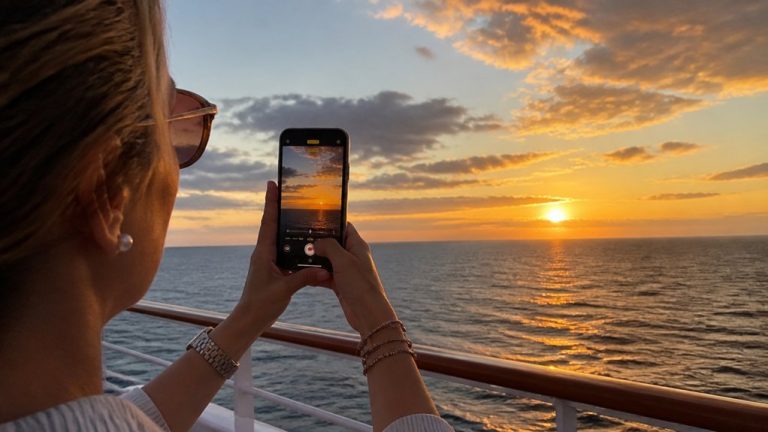

You can get smooth boat video, but the water won’t give it to you for free. Every swell nudges your frame, salt spray sticks to your screen, and even your stance matters when the deck starts shifting under your shoes. If you secure the camera, lighten the rig, and work with the boat instead of against it, your footage changes fast. A few smart moves make all the difference.
Key Takeaways
- Rigidly mount the camera to the boat with clamp tripods or padded suction mounts, and add safety tethers plus rubber protection.
- Match stabilization to conditions: handheld gimbals for light chop, gyros or fixed mounts for rougher water or chase-boat shots.
- Use wide, stabilized lenses and avoid heavy telephotos; shoot 4K and crop later for extra reach.
- Keep exposure manual with shutter near double frame rate, fixed white balance, and ND filters for natural motion blur.
- Brace your body with bent knees and a tight core, coordinate with the skipper, and move with the boat’s rhythm.
Get Stable Boat Video First

Often, the smoothest boat footage starts with a simple move: make the camera part of the boat. Clamp a tripod to the rail, bolt on a deck high hat, or scatter a few small 4K cameras on deck where spray and engine rumble feel cinematic. That shared motion keeps horizon and subject moving together, which looks calmer than a floating handheld frame. You should keep the camera small too. A light body with a stabilized lens, a cinema camera, or an action cam cuts fatigue and helps adjustments stay clean. Add a tuned gimbal for handheld moments, or a gyro system on bigger jobs. Stay wide rather than chasing long glass. Tether every support, shield lenses from salt, and coordinate shots with a skipper. On catamaran cruises, best shots often come from anticipating the boat’s rhythm and framing with the waterline to enhance smooth-looking motion.
Brace Yourself for Boat Shooting
Before you chase smooth shots over a rolling deck, you’ve got to steady your own body first. You’ll shoot better when you medicate for seasickness ahead of time, clip into the boat with a proper harness, and plant yourself like the wet deck just gave you a challenge. Taking motion-sickness medicine before boarding can make a big difference on catamaran cruises. With kneepads, a light helmet, and one hand ready to brace, you can stay balanced while the hull groans and the water keeps moving under you.
Stabilize Your Stance
When the deck starts to roll under your shoes, your body should do the stabilizing so your camera doesn’t have to. Plant your feet shoulder width apart, bend your knees, and tighten your core. That stance soaks up pitch and roll instead of sending it straight into your hands. Compared with standing stiff legged, you’d cut shake dramatically and keep the horizon calmer.
On longer shoots, it also helps to know where the boat bathrooms are so you can stay comfortable and avoid rushing your setup between takes. Turn slightly into the boat’s motion, as if you’d quarter the swell where a bicycle would go. Keep your chest forward and your center low. Tuck one elbow into your ribs and nestle the camera against your sternum or shoulder. If you need to move, glide in two or three small steps, timed to the hull’s rhythm, then roll a beat early and late.
Secure Yourself Safely
Always secure your body before you worry about the shot, because a rolling deck can turn one small slip into a fast, wet problem. Wear a Coast Guard-approved PFD and a light skateboard helmet marked with reflective tape and your blood type. If you’re moving on deck, tie into the boat with a hip harness or stout tether clipped to a rail, never to the camera. Test Dramamine or Marezine before shoot day, then pack extra tabs onboard. Add rubber mats underfoot, kneepads on your legs, and foam on sharp gear edges. Tape down tripods and sleds so nothing skates when the hull lurches. Let a crew member tail your safety line, talk with the skipper, and skip swinging heavy rigs in rough water. Before departure, review basic catamaran cruise safety essentials with the crew so everyone knows emergency procedures and deck movement risks.
Still comparing How To Film Smooth Video On A Boat?
Ask for tour ideas, hotel suggestions, or a simple trip plan that combines both.
Trip Helper
Strip Down Your Camera Rig
Start by stripping the rig back to the essentials, because every extra bracket, handle, and matte box turns the boat’s bounce into a bigger problem in your hands. On a small boat, go barebones. Ditch follow-focus gear and bulky handles. Keep one stabilized lens. Use crop mode for extra reach instead of heavy zoom add-ons. Skip full shoulder rigs in chop. A gimbal, tiny shoulder pad, or short monopod lets you move fast and stay fresh. In Waikiki, a catamaran cruise is often fairly smooth in calm weather, but ocean chop can still make a bulky rig harder to control.
| Keep | Lose | Why |
|---|---|---|
| IS lens | Matte box | Less sway |
| Quick plate | Top handle | Faster resets |
| Crop mode | Zoom controller | Quicker moves |
| Small mount | Counterweights | Less fatigue |
Strip menus down, clear overlays, carry fewer batteries and cards, and you’ll swap setups before the spray dries on deck between shots.
Choose a Light Camera Setup

A lighter camera setup gives you room to react instead of wrestling gear every time the hull slaps a wave. You’ll last longer with a compact body like a 5D Mk IV or C100, and your handheld shots stay practical through a full day of spray and engine rumble. Keep the build lean and use stabilized lenses, because every extra ounce amplifies the deck’s pitching. If you need more reach, use cropped 4K on a 5D-class camera. That move would save weight better than hanging a heavy telephoto over the rail. For close boat-to-boat work, a small 4K camera or Osmo-style gimbal feels nimble in three to four foot swells. You can also mount several tiny cameras aboard and keep yourself mobile out there. If you want more action angles without adding bulk, GoPro tips for catamaran cruises can help you capture epic moments from multiple mounting points.
Use Wide Lenses on Boats
Perspective becomes your best deckhand once the hull starts bouncing. A wide angle lens keeps motion looking calmer because its broad view softens boom, roll, and sudden surge. You can shoot one-handed, swap shoulders fast, and still keep your subject in frame when the deck pitches under your shoes. Wider focal lengths forgive mistakes, which matters when salt spray stings and the engine hum turns every adjustment into adventure. On busy charters around Waikiki, filming from the best seats can also reduce how dramatic motion looks because central positions on a catamaran often feel steadier than the bow or stern.
- Choose 16–35mm full-frame or 10–22mm APS-C for forgiving framing.
- For boat-to-boat scenes, use 24–35mm and include sea plus deck rails to mask small shifts.
- Pair IS or IBIS with about 1/50 at 25fps for natural blur and less jitter.
- Shoot 4K when you can, then crop for extra reach while footage still feels smooth.
Avoid Long Lenses in Rough Water
Skip the giant telephoto when the water turns lumpy. On a chase boat or any small platform, anything past about 135mm magnifies every surge, slap, and rocker-panel shudder until your footage turns jumpy mush. For boat to boat shots, keep your focal length short and your framing practical. If you need extra reach, crop 4K instead of hanging a 300mm cannon off the camera. You’d rather lose a little edge than lose the shot. On a catamaran cruise in Waikiki, the difference between a catamaran and a boat cruise can also affect how much deck motion ends up in your footage. When safety or composition forces a longer lens, mount the camera to the boat with a clamp tripod, deck mount, or fixed rig so the camera moves with the hull. And if you truly need telephoto at sea, rent real marine stabilization and test it in actual chop before shoot day.
Use Lens IS for Boat Video
Often, the cheapest stabilization upgrade on a boat is the lens in your hands. Use optical IS, OSS, or VR when you shoot handheld or from your shoulder. You’ll see less slow roll and pitch in ordinary swells, and your footage feels calmer fast. For sunset cruise photos, dialing in the best phone settings can also help preserve color and detail as the light drops.
- Pick a stabilized short-to-mid zoom, around 17 to 55mm equivalent, when you share the boat with your subject.
- Skip long primes unless you add more support. They magnify every wobble and turn deck bounce into jelly.
- Need more reach on full frame? Try crop-mode 4K with a stabilized lens for cleaner boat-to-boat shots.
- Turn on the right IS mode for panning or boat motion, and keep your rig light so the stabilization can work harder through the salt-bright afternoon chop.
Match Stabilizers to Sea Conditions
Usually, the sea tells you what stabilizer to bring long before the first take. In light chop, with one- to three-foot swells, you can move fast with a small handheld stabilizer like a DJI Osmo or compact gimbal. Pair it with 4K capture and you’ll often get clean, usable footage without a circus of gear. If you’re filming during catamaran cruise season in Waikiki, calmer parts of the year can make lightweight stabilization setups more practical. When seas build to three to six-foot rollers, or you’re shooting from a chase boat, step up to a gyro like Perfect Horizon or Kenyon. Longer lenses past 135mm turn handheld shots into abstract art. On small, pitching boats, keep setups stripped down and test every gimbal or gyro on real water first. If profiles fail, simpler stabilizers are quicker, safer, and far less likely to bite back today
Mount Cameras to the Boat

Once you stop fighting the boat and start attaching the camera to it, the motion suddenly makes a lot more sense on screen.
- Clamp tripods or use padded suction mounts on railings or deck beams. You cut relative movement and keep the horizon feeling honest.
- Protect glossy fiberglass with rubber matting, then add safety tethers. Salt spray is sneaky, and the sea loves expensive gear.
- Mount small 4K cameras on fixed brackets around the boat. Later, you can fake gentle pans in post without a wandering operator.
- Tie sleds,high-hats,or track-mounted dollies to strong boat structure (not just sandbags) so they cannot roll downhill as the boat pitches and roll changes direction. Skip bulky counterweights. Use tethered gyro-heads or light gimbal arms instead onboard today.
If you’re filming on a passenger charter, ask ahead about boat accessibility so your mounted gear does not block boarding paths, rail access, or crew safety zones.
Set Your Camera for Boat Motion
Mounting the camera to the boat gives the motion a logic, and your settings need to match that rhythm. Set shutter speed near double your frame rate, like 1/50 for 25fps or 1/60 for 30fps, so waves blur naturally but details stay readable. Shoot manual exposure with fixed ISO, aperture, and white balance, or the camera will chase bright sky and dark water. Keep your aperture around f/4 to f/8 for focus forgiveness, and use ND filters in hard sun. Turn on optical stabilization. Wider focal lengths work very well because they soften surge, while long lenses exaggerate every pitch. If your camera offers cropped 4K, use it for reach. On gimbals or an Osmo, 4K also gives you room to stabilize later. If you are also appearing on camera during a Waikiki catamaran cruise, choose practical clothing that will stay comfortable and look neat in wind and spray.
Protect Gear From Salt Spray
Salt is the quiet troublemaker on a boat, and it can turn a great shooting day into a sticky cleanup if you don’t stay ahead of it. When chase boats throw spray, seal your camera in clear plastic or a zip-top bag, with a neat slit for the lens. For a Waikiki catamaran cruise, pack a dry bag and a towel so you can shield your gear quickly between shots.
Salt sneaks up fast on boats, so bag your camera before the spray turns a smooth shoot into a sticky mess.
- Screw on cheap UV or waterproof clear filters. They take the abuse, not your glass.
- Keep a spray bottle of fresh water and a clean chamois handy. Rinse and wipe salt fast.
- Tape exposed ports or plug them with silicone. Keep aluminum bodies especially dry.
- Once ashore, rinse gear with fresh water, dry it well, and blow canned air into crevices before storage. Don’t open wet compartments or run wet lenses after a soaking ride.
Use Drones Carefully on Boats
You’ll get stunning over-water shots with a drone, but a rocking deck turns takeoff and landing into the trickiest part of the flight. Launch only when you’ve got calm space or a practiced hand-catch routine, and keep updating the home point so your drone doesn’t try to fly back to where the boat used to be. If the boat’s bouncing and the drone can’t lock in cleanly, wait for a steadier moment or use the dock, because the sea is a lousy landing pad. In Hawaiʻi, remember that humpback whales must be viewed from at least 100 yards away, and federal law prohibits approaching them by boat, kayak, drone, swimming, or other means.
Safe Launch And Recovery
Launching a drone from a boat feels a bit like catching a paper airplane on a moving sidewalk, so the safest approach is to keep everything simple and practiced.
If squalls move in like they do on a Waikiki Catamaran Cruise, it’s usually smarter to reschedule than force a risky launch or recovery on a wet, shifting deck.
- Choose a small folding drone. It’s easier to hand-catch and less punishing if it bumps fiberglass or rails.
- In order to keep launch and recovery calm, avoid a pitching deck. If you must use it, assign a pilot, a catcher, and a clear zone while the skipper holds steady nearby.
- Rehearse startup, hand-catches, and motor shut-down on land first. Grab the body, never the props, and secure it fast.
- Set shorter battery limits, brief abort plans, and keep a soft capture bag on a pole ready. Boats love surprises enough already, especially when spray, wind, and engine rumble join the show.
Home Point And Hazards
Once the drone is in the air, the next trick is teaching it where “home” really is, because on a boat that address keeps sliding across the water. Update Home Point often, or use a mobile RTH, so signal loss won’t send it to yesterday’s wake. In Hawaiian coastal waters, avoid launches or recoveries when Small Craft Advisories are in effect or when seas are building sharply Monday night into Tuesday.
| Check | Why | Safer move |
|---|---|---|
| Home point | Boats drift | Refresh time to time |
| Deck recovery | Decks pitch | Hand catch with trained crew |
Calibrate while you’re stationary because GPS, compass, and IMU quirks show up more on moving platforms. Choose small folding-prop drones with slower props if you can. If you must recover onboard, avoid rough seas and tight decks. Brief your catcher on emergency cut steps, and keep a shore-based backup plan ready if home goes fuzzy offshore.
Recover Drones Safely on Boats
On a moving boat, drone recovery matters more than the takeoff, because the deck shifts, the wind swirls, and auto-return can suddenly become very confused. On tours like an accessible catamaran cruise, crews often prioritize stable boarding and deck safety, which makes a clear drone recovery plan even more important underway.
At sea, getting the drone back is the hard part: moving deck, messy wind, and return-to-home can lose the plot.
- Keep updating the home point while you’re underway, or set shore as home. It makes recovery much easier.
- Use a trained spotter. Brief every step, name an emergency ditching plan, and keep a tethered float ready.
- Hand-catch when conditions are calm. Hover low, grab the body, never the arms, then cut power. Practice ashore first.
- Skip automated deck landings. Slow the boat, point into the swell, clear and pad space, and use small folding-prop drones with guards. If you must land onboard, commit to a firm two-foot slam landing when the deck won’t stop bouncing like a nervous drum.
Use Post Stabilization as a Backup
Treating post stabilization like a backup parachute keeps your boat footage looking calm even when the deck had other ideas. You should still shoot at the highest resolution and use a flat picture profile, because extra detail gives stabilizing software more to hold onto. Frame a little wider, about 10 to 20 percent, so the crop won’t bite into your subject.
Before you run Warp Stabilizer, DaVinci Stabilizer, or ReelSteady, transcode to ProRes or DNxHR. Cleaner files help the software read waves, rails, and sky without crunchy artifacts. If you’re filming before boarding, planning for Waikiki catamaran parking early can keep your setup calm and steady before you ever step on deck. Lock the horizon or set reference frames, then tune smoothness, crop, and motion method until the clip feels natural. Heavy roll or long telephoto shake would look better fixed on deck than in post, honestly, first.
Frequently Asked Questions
How Do I Record Clean Audio on a Noisy Boat?
You’ll get clean boat audio by using Windproof microphones close to mouths, adding a backup lav, engaging low-cut filters and input pads, blocking wind, monitoring with headphones, and recording reference tone for noise reduction later.
What Safety Rules Should Camera Operators Follow Onboard?
Follow this Safety checklist: wear a Coast Guard-approved PFD, tether your harness to the boat, secure all gear, use non-slip shoes and a helmet, carry VHF and throw bag, test seasickness meds, protect electronics carefully.
How Can I Prevent Seasickness While Filming at Sea?
Channel your inner Odysseus: take Dramamine or meclizine before boarding, stay in fresh air, watch the horizon, snack lightly, sip water, try Ginger remedies and Sea-Bands, and schedule short breaks so you don’t get overwhelmed.
What Power Solutions Work Best for All-Day Boat Shoots?
You’ll get the best all-day power from V-mount batteries, Battery Banks, and a pure sine inverter. Rotate labeled packs, hot-swap your camera, charge spares continuously, and keep every cable dry in waterproof cases onboard too.
Do I Need Permits to Film From Boats in Public Waters?
You usually don’t need federal permits for non-disruptive filming from private boats in public waters, but Permit requirements change if you disrupt navigation, use drones, dock at marinas, or film commercially, so check local authorities early.
Conclusion
You’ll get smoother boat footage when you keep your rig light, your stance loose, and your plan simple. Clamp down the camera, brace with your knees, and let a wide lens drink in the horizon, the slap of wake, and the glitter of salt on rails. Treat your drone like a homing pigeon with manners. If the sea still jostles the frame, leave room for post. Clean gear fast, and you’ll sail home with shots.