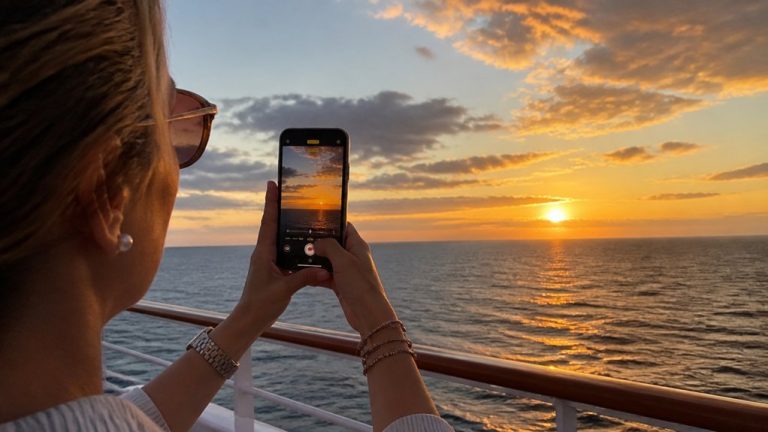

Like Odysseus with a dry bag, you’ll get your best catamaran shots by moving with the boat, not fighting it. Try the bow for airy wide frames, then shift aft as the sun slides and spray changes the mood. Keep your shutter fast, your horizon level, and one hand braced on the rail. Salt, glare, and sudden wildlife cameos all raise the stakes, and that’s where things get interesting.
Key Takeaways
- Shoot from the bow, leeward rail, trampoline, and stern to vary perspective, use leading lines, and keep the horizon level.
- Start at 1/500s, raise to 1/1000s in rough water, and use burst mode with continuous autofocus for moving subjects.
- Use ISO 200–400 in sun, 800–1600 in clouds, and protect sail and water highlights with slight negative exposure compensation.
- Rotate a circular polarizer to reduce glare and deepen water color, but compensate for its 1–2 stop light loss.
- Stay low, brace against the rail, keep one hand free for safety, and protect gear with dry bags, splash covers, and microfiber wipes.
Choose the Best Spot on the Catamaran

Start at the bow and you’ll see why photographers love the foredeck. From here, you can shoot low and let the wake pull the eye into the frame. A 16–35mm makes the catamaran feel big, airy, and fast.
Then test the leeward side for steadier footing and less spray. You can brace at the rail, watch midday reflections flicker, and keep your shirt a little drier. Move amidships or onto the trampoline for portraits, where soft light bounces off the water and faces look relaxed. Near the helm or stern, you’ll catch crew banter, lines coiling, and maybe dolphins riding the wake. Bring a 70–200mm for those tighter moments. Rotate spots through the day, and the boat keeps giving at every change in light. If you want the strongest compositions, the best seats often shift with sun angle, spray, and the kind of story you want your photos to tell.
Use Fast Settings for Sharp Catamaran Photos
To keep your catamaran photos sharp, start with a fast shutter speed of at least 1/500s, and push to 1/1000s when the sea gets jumpy or wildlife moves fast. Don’t be shy about raising your ISO to hold that speed, especially when clouds roll in or the light turns gold and soft. Then switch on burst mode so you can fire off a quick sequence and catch the one frame where the boat, the spray, and your timing all line up. If you’re shooting action from the deck, GoPro tips can help you capture quick, dramatic moments without missing the shot.
Prioritize Fast Shutter Speeds
Lock in a fast shutter speed before the catamaran picks up speed, because even bright blue water and a steady hand can’t outrun hull slap, spray, and the boat’s constant sway. On a moving platform, aim for at least 1/500s to freeze wave chop, deck vibration, and your own handheld wobble. Push the shutter to 1/1000s or faster when dolphins leap through the wake or crew snap lines into place. Use shutter-priority or manual with auto settings so your camera protects that target while the light shifts off the sail. For glowing evening scenes, dial in sunset cruise photos settings early so your phone can balance warm sky color with motion-free detail. Turn on stabilization and brace at the rail, but don’t trust it to beat boat motion alone. Pair that fast shutter speed with burst mode, and you’ll catch sea, sail, and sunlight line up perfectly.
Raise ISO Strategically
Bump your ISO without guilt when the catamaran starts tossing you around, because a little grain looks far better than a beautiful blur.
- Start at ISO 200 to 400 in bright sun.
- In clouds or golden hour, raise ISO to 800 to 1600.
- Set Auto-ISO with a 3200 cap and a shutter speed floor.
- With image stabilization, you might use one stop less ISO.
Aim for 1/500s, or 1/1000s for wildlife and bow spray. Keep your aperture where you want it, then let ISO do the lifting. Tie your minimum shutter speed to focal length, especially handheld on deck. Check your histogram and zoom into frames. If sharpness slips, raise ISO one stop instead of slowing down. Your keeper rate will thank you later. If you’re prone to motion sickness, dialing in settings before departure can help you spend less time fiddling with controls once the Waikiki catamaran gets moving.
Still comparing Catamaran Cruise Photo Tips: Best Shots On The Water?
Ask for tour ideas, hotel suggestions, or a simple trip plan that combines both.
Trip Helper
Use Burst Shooting
Once your shutter speed is safe, let burst mode do the rest. Switch to high-speed continuous and fire at 8 to 20 fps, or whatever your camera can handle, when a dolphin breaks the surface or the deck gives a sudden lurch. Keep shutter speed at 1/500 to 1/1000s minimum, and push ISO if clouds roll in. Turn on stabilization, stabilize your camera against the rail, or lean into a monopod or gimbal when you can. Set AF-C/continuous autofocus with zone or tracking so focus sticks as the catamaran bobs and spray hisses past. Keep each burst short, about one to three seconds. You’ll avoid buffer slowdowns, spend less time reviewing, and quickly spot the frame where everything snaps crisp in the bright chop. Because Waikiki sails can range from smooth waters to choppier conditions depending on wind and swell, burst shooting gives you a better chance of catching a sharp frame.
Brace and Stabilize Your Camera on Board
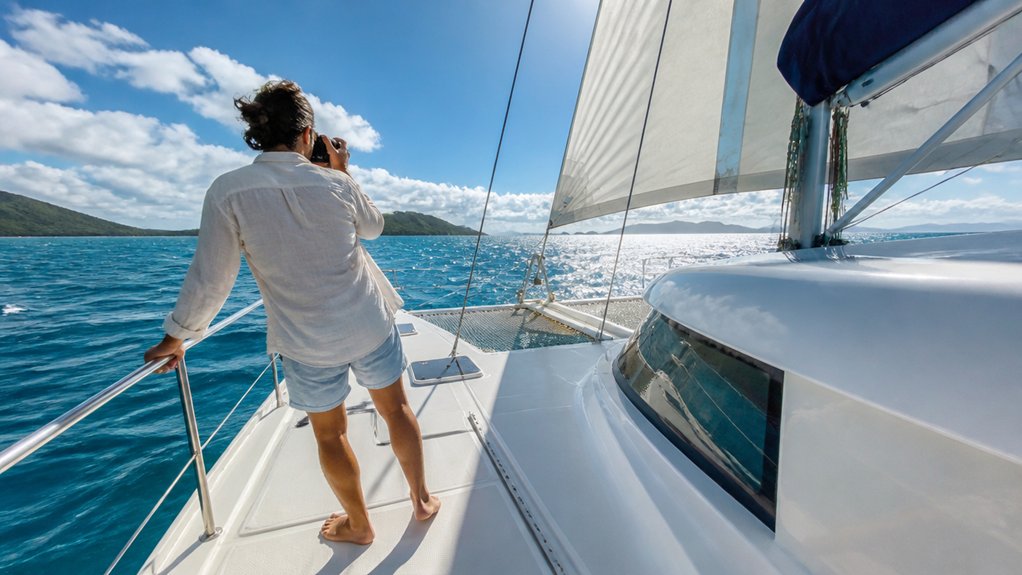
Plant your feet and work with the boat, not against it. You’ll shoot sharper frames if you brace against a rail, cabin top, or even a cooler. Tuck your elbows, bend your knees, and stay low as the deck shifts under your shoes.
- Use in-body or lens stabilization and a fast shutter, around 1/500 to 1/1000s.
- With telephoto lenses, clip a monopod into a deck bracket or steady it on the rail.
- Keep one hand on the rail and the other on your camera.
- Shoot bursts and breathe slowly, then stash extra gear in dry bags.
Using image stabilization helps smooth out the constant motion of the boat and makes your footage feel more cinematic. That little routine fights wake-induced vibration, saves your arms in rough seas, and gives you more keepers when the hull slaps, the wind rises, and the horizon starts joking.
Cut Glare in Bright Catamaran Photos
To tame that hard midday sparkle, you can twist on a circular polarizer, watch the glare slide off the water, and make the blues look richer without much fuss. You’ll get better results if you shift your shooting angle a few degrees, because a small change can calm reflections on the sea without turning the whole sky oddly dark. Keep an eye on bright highlights and shoot RAW, because when sunlit ripples start flashing like mirrors, it’s much easier to lift shadows later than fix blown-out shine. If you’re packing gear for the sail, keep catamaran cruise essentials in mind so your camera stays protected and easy to access in Waikiki conditions.
Use A Polarizer
Why do some midday catamaran shots look washed out even when the water is blazing blue? A circular polarizer (CPL) can reduce reflections on chop, cut glare by about 1–2 stops, and reveal coral, hull shadows, and richer color below the surface.
- Rotate it while you frame so you can watch glare fade in real time.
- Expect about a 1-stop light loss, so raise ISO, open aperture, or keep shutter above 1/500s.
- Use it to deepen skies and boost contrast at noon, especially with sparkling spray.
- Wipe salt mist with a microfiber cloth, keep a protective filter underneath, and stash it dry.
On a Waikiki sail, checking the dress code ahead of time can help you choose practical, photo-friendly clothing that looks good on deck and handles bright sun and sea spray.
Skip it when you want mirror-like reflections or wide views with uneven skies. Think of it as sunglasses for your lens, minus the beach attitude.
Change Shooting Angle
A polarizer helps, but your position on the cat matters just as much. To cut glare, tilt your camera down about 10 to 20 degrees, or sidestep along the deck until the water shows texture instead of white flash. When the sun is high, aim so it’s 30 to 90 degrees off to your side or back side. That angle gives waves shape and richer color.
You can rotate circular polarizer while watching the histogram, then stop before the scene looks too heavy. Better yet, shoot low on the bow or trampoline, where the reflection angle often cleans up the water. On a Waikiki cruise, wearing lightweight clothing can also help you move easily into better shooting positions without feeling restricted. Brace against the rail, bend your knees, and increase shutter speed ≥1/500s. The cat moves, you move, and blur loves both.
Control Exposure Highlights
Bright decks and hard noon sun can fool your meter fast, so protect the highlights first. Photographing From A Boat gets easier when you Expose to preserve highlights and trust the histogram, not the sparkle.
- Rotate a CPL (circular polarizer) until glare lifts off the hull and water. Colors deepen too.
- Expect 1 to 2 stops of light loss. Open aperture, raise ISO, or add +1/3 to +2/3 EV.
- Use -0.3 to -1.0 EV or spot meter bright reflections to save whites on sails.
- Nudge your angle a few degrees to the sun. Tiny shifts tame harsh shine.
On longer sails, knowing the boat layout, including bathrooms aboard, helps you move quickly and avoid missing fleeting light. Shoot RAW, turn on blinkies, and set white balance later. Sunlit fiberglass loves clipping, and it has no mercy. Your images will thank you later.
Frame Better Photos on a Catamaran

How do you make a catamaran photo feel alive instead of flat? Start low on the trampoline or deck with a 16-35mm lens. Let the bows, hulls, and rigging create leading lines that pull eyes toward the horizon. Keep that horizon level, then add wake, ropes, and a crew member trimming sails so the frame tells a real boat story. Because everything shifts, use fast shutter speeds around 1/500 to 1/1000s and burst mode for more keepers. Brace against a stanchion or coachroof, enable stabilization, and try a monopod with longer glass. A circular polarizer cuts glare and deepens blues, but it steals light, so raise ISO or open your aperture. For better cruise safety, keep one hand free and stay aware of wet decks while shooting. Your shots will feel steadier, saltier, and far more cinematic at sea today.
Time Wildlife and Wave Shots From the Boat
When dolphins start pacing the bows or a shearwater skims the chop, set your camera for speed before the moment breaks.
- Use 1/500 to 1/1000s, or faster for tiny birds, to freeze the action.
- Switch to continuously/burst mode and track with zone AF or back-button focus.
- Brace against the rail with stabilization or a monopod when you reach for 70–200mm or 100–400mm.
- Add a polarizer to cut glare, then raise ISO and watch highlights on bright water.
On Waikiki catamaran cruises, dolphin sightings are common enough that keeping these settings ready can pay off fast. You’ll catch predictable surfacing if you study rhythm and keep the boat parallel or downwind. For waves and wake, try 1/500s for crisp spray, 1/60 to 1/250 for blur, or below 1/30 for painterly streaks. Water rarely waits. The hull hums, spray flashes silver, and timing turns luck into photographs.
Protect Camera Gear From Spray and Salt
Fast shooting is only half the boat game. When you’re not shooting, stash your camera in a waterproof dry bag or Pelican case, and tuck silica gel packs inside to soak up salt moisture before it creeps into contacts. While you shoot, slip on a neoprene or silicone splash cover so spray stays off the body and lens without slowing your fingers. Add a UV protective filter too. It’s cheaper to sacrifice glass than a lens element. If you’re booking with Waikiki accessibility in mind, ask ahead whether secure, dry storage areas are available onboard for camera gear. Keep straps on, tether heavy lenses, and wipe salt spray fast with a microfiber cloth. After the trip, rinse with fresh water or a damp wipe-down, then dry everything in shade with moving air. Boats love surprises, and your gear shouldn’t take the plunge today for fun.
Frequently Asked Questions
Can I Fly a Drone From a Catamaran During the Cruise?
Yes, you can fly a drone from a catamaran during the cruise if you follow legal restrictions, coordinate launch procedures, watch signal interference, manage battery management carefully, and obey the captain’s safety decisions at sea.
What Should I Wear for Comfortable Photography on a Sunny Boat Trip?
Obviously, you’ll want to dress like the sun’s your stylist: wear Light layers, Grip footwear, a Sunscreen hat, and Polarized sunglasses. Add a packable shell and fingerless gloves, so you stay cool, steady, and ready.
How Do I Prevent Seasickness While Trying to Shoot Photos?
Prevent seasickness by choosing midship, using hydration strategies, smart meal timing, and gaze fixation on the horizon. You can try acupressure techniques, take motion-sickness medicine before boarding, brace yourself, and shoot in short bursts too.
Are There Privacy Rules When Photographing Other Passengers Onboard?
Yes, play it by ear: you should check onboard policies and local laws, obtain consent for portraits, respect boundaries, avoid closeups without permission, and mute notifications when sharing images so you don’t reveal private details.
Should I Bring a Phone Camera or a Dedicated Camera System?
Bring both, you’ll win the Phone vs.Mirrorless debate by using your mirrorless for quality and Lens Flexibility, your phone for shares and Backup Strategy, while checking Durability Considerations like weather sealing, straps, bags, and spray protection.
Conclusion
Out on the water, you don’t need luck. You need a low angle, a steady stance, and quick settings when the deck starts to dance. Let the bow, wake, and rigging guide your eye. Watch the horizon. Chase the brief silver flash of a fish or the curl of a wave. Then wipe the salt, stow your gear, and look up. The sea is a restless studio, and you’re ready to shoot it well today.